
There’s something quietly powerful about standing still while the day ends.
I’ve seen sunsets all over the world, and somehow they never get old. No matter where I am, I feel it in my body first. My shoulders drop. My breathing slows. My blood pressure—yes, the stubbornly high one—seems to ease just a bit. I don’t have a cuff to prove it in the moment, but I know the feeling well enough to trust it.
A Small Dose of Science (the gentle kind)
Watching a sunset does more than please the eye. As daylight fades, our brains begin to shift gears. Exposure to natural light—especially the softer, warmer hues of late evening—helps regulate our circadian rhythm. As the bright blues of daytime give way to reds, oranges, and purples, the brain reduces cortisol (the stress hormone) and allows melatonin to rise. Translation: your nervous system gets the message that it’s okay to calm down now.
That sense of calm I feel? It’s not imagined. Sunsets invite the parasympathetic nervous system—the “rest and restore” mode—to step forward. Even a few minutes of quiet observation can slow the heart rate and ease mental chatter. For me, they bring order to chaotic thoughts, like someone gently shuffling papers into neat piles.
The Colors That Stop Me Every Time
No two sunsets are the same, and that’s part of the magic. The colors come from light scattering through the atmosphere. When the sun is low, its light travels through more air, filtering out shorter blue wavelengths and leaving behind the warm reds, golds, and pinks. Add clouds, dust, or sea air, and the sky turns painterly—layered, dramatic, unforgettable.
Sometimes, if you’re lucky and watching closely, there’s a fleeting phenomenon called the green flash—a quick green glimmer as the sun slips below the horizon. It lasts only a second or two, and seeing it feels like being let in on a secret the sky doesn’t share with everyone.
Where the World Does Great Sunsets (and Why)
The most vivid sunsets tend to happen where the air is clean but layered with just enough particles to scatter light beautifully. Coastal areas, deserts, and places with wide, open horizons often steal the show. Some of the best in the world:
- Puerto Vallarta, looking across Banderas Bay, where the sun melts into the Pacific and the sky reflects back off the water.
- Costa Rica, anywere on the west coast.
- The Rocky Mountains, where altitude and dramatic cloud formations add depth and intensity.
- Rio de Janeiro, the name says it all.
- At sea, on a cruise ship, with nothing but water in every direction—pure horizon, uninterrupted.
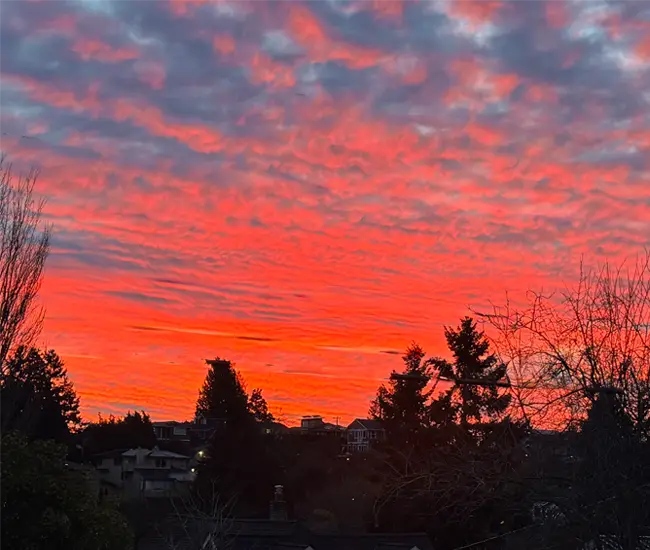
- Seattle, from the back deck of my home, where clouds often cooperate in the most surprising ways.
Water, elevation, and atmosphere all play a role, but I think familiarity matters too. A sunset you’ve watched from the same spot, over and over, becomes personal. It marks time. It remembers you.
My Favorite Places to Watch the Day End
If I had to choose favorites, they’d be tied not just to beauty, but to how I felt standing there:
- Puerto Vallarta, warm air, ocean breeze, watching the light fade across the bay
- My back deck in Seattle, often wrapped in quiet, the sky putting on a show just for those paying attention
- The window of an airplane.
- The Rocky Mountains, where the sun disappears behind peaks and leaves the world hushed
- Any cruise ship, any body of water—because sunsets at sea remind me how small and lucky we are. A Daily Invitation
- Driving down the road – sometimes the most surprising and gorgeous.
Sunsets don’t ask for anything. No tickets. No reservations. Just a pause. A willingness to look up and stay still long enough to notice.
In a noisy world, they are a daily reminder that endings can be beautiful—and that sometimes, the healthiest thing we can do is watch the light fade and let ourselves soften with it.